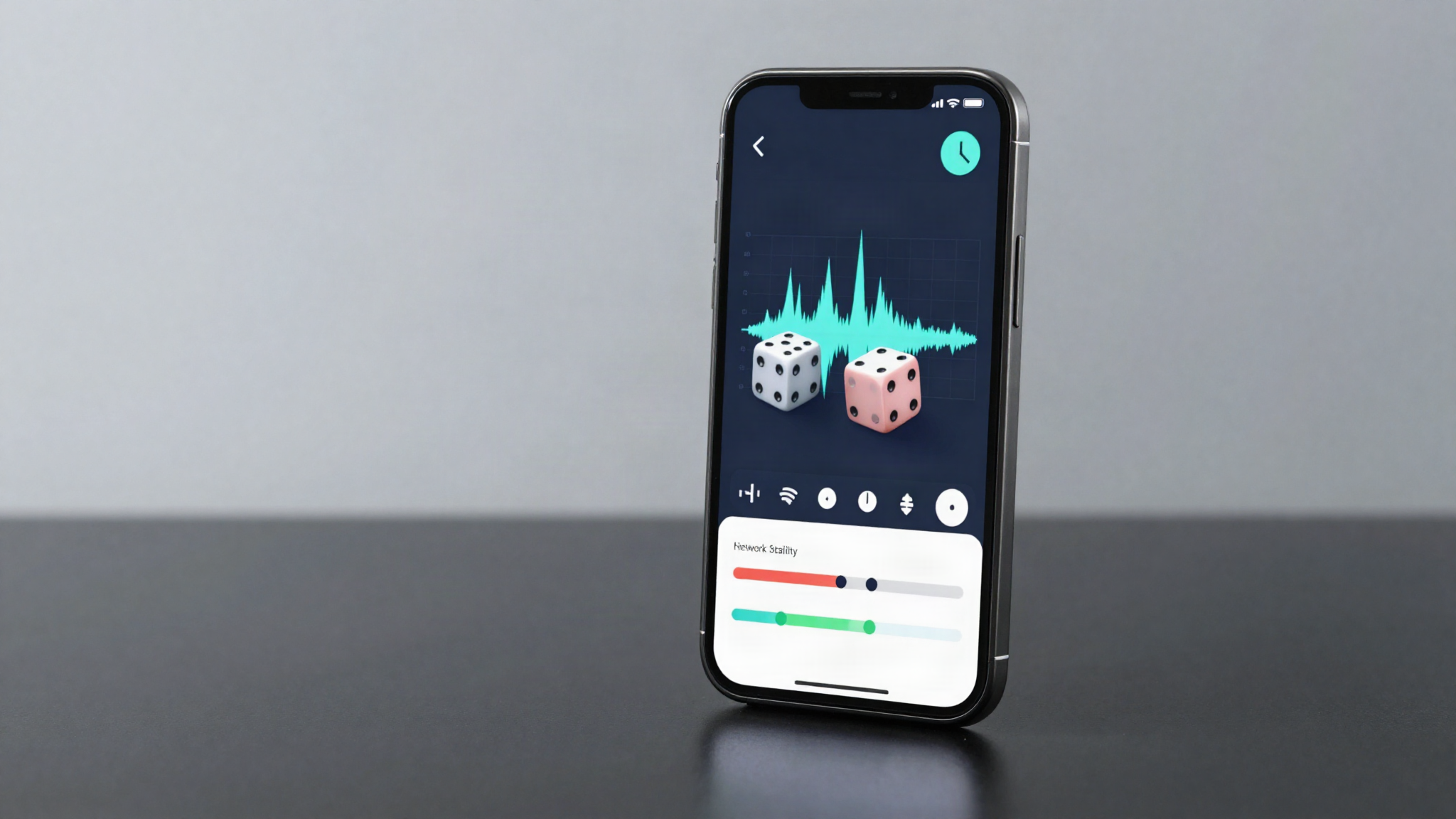
Real-time mobile dice games depend on more than a colorful interface. Every selection travels from the phone to a remote system, is checked against a closing time, and returns with a confirmation or result. When that exchange is delayed, users may see a button react locally even though the action has not yet been accepted. Understanding connection states, timestamps, and round records is therefore an important part of using any live gaming interface carefully. It reduces confusion without pretending that technology can predict a random outcome.
Contents
- Latency Is Different From Download Speed
- Learn the Four States of a Mobile Action
- Compare the Screen Clock With the Round Status
- Read the Rules for Delayed or Interrupted Rounds
- Run a Connection Check Before Starting
- Respond Carefully to a Disconnect
- Use Records to Reconcile, Not to Predict
- Add Time and Spending Limits to the Technical Checklist
Latency Is Different From Download Speed
A fast connection can still respond inconsistently. Download speed measures how much data can move, while latency measures how long a request takes to travel and return. Live dice rounds use little data, but they are sensitive to timing. A connection that pauses for one or two seconds may be less reliable than a slower connection with steady response times. Signal bars alone cannot reveal that difference, especially when a phone is switching between Wi-Fi and mobile data.
Learn the Four States of a Mobile Action
A well-designed interface distinguishes between selection, submission, acceptance, and settlement. Selection means an option is highlighted only on the device. Submission begins when the user confirms it. Acceptance occurs after the remote system records it, ideally with a round number and timestamp. Settlement happens after the result is finalized and the account record is updated. Treating a highlighted button as proof of acceptance is a common mistake when the connection is unstable.
Compare the Screen Clock With the Round Status
When examining an interface connected with YO88, focus on whether the countdown, current round identifier, confirmation message, and history panel agree with one another. A countdown shown on the phone may be an estimate synchronized with server time rather than the final authority. If an action is submitted near the cutoff, the server record should determine whether it arrived on time. Avoid repeated taps while waiting, because they can create additional uncertainty.

Read the Rules for Delayed or Interrupted Rounds
A game guide such as Tài xỉu YO88 may help users locate relevant terminology, but the operational rules deserve separate attention. Look for explanations of canceled rounds, duplicate requests, connection loss, disputed results, and maintenance interruptions. The rules should clarify whether an unconfirmed action is void, how balances are restored, and which identifier support requires when reviewing an incident. Do this before a problem occurs rather than during one.
Run a Connection Check Before Starting
Close large downloads, disable automatic network switching if it regularly causes interruptions, and confirm that the device clock is set automatically. Open and close a nonfinancial section of the service to see whether pages respond consistently. If the interface repeatedly reconnects, freezes, or displays old information, stop there. Changing networks during an active round can make the visible screen lag behind the recorded state, so wait until all activity is settled before moving from Wi-Fi to mobile data.
Respond Carefully to a Disconnect
After a connection failure, do not assume that an action failed or immediately submit it again. Reconnect, refresh the account record, and match the round number with the transaction history. Save the relevant identifier and time if the status remains unclear. A screenshot can document the screen, but remove or cover personal details before sharing it with support. Never send passwords, one-time codes, full payment credentials, or remote access to anyone claiming to investigate the issue.
Use Records to Reconcile, Not to Predict
Round history is useful for comparing submitted actions, accepted timestamps, outcomes, and balance movements. It does not reveal what the next dice result must be. Network delay may change when information appears on a screen, but it does not turn previous results into a forecasting tool. Review the record for accuracy, not patterns. If an entry cannot be reconciled, pause further activity until support provides a clear explanation.
Add Time and Spending Limits to the Technical Checklist
A stable connection does not make a chance-based game financially safe. Before opening a session, confirm local legality and age eligibility, set a fixed time limit, and choose a spending ceiling that does not affect essential expenses. Stop when either limit is reached and never increase it to recover a loss. The best mobile routine combines technical awareness with the willingness to leave: verify the network, wait for explicit confirmation, check the record, and end the session whenever the interface or your decisions stop feeling clear.